GMP regulations for cleanrooms are constantly evolving. The European Regulation has imposed a series of requirements and changes to be implemented by companies in the cosmetics and pharmaceutical sectors, as well as any other sector that needs to use cleanrooms or sterile areas. If you are concerned about obtaining GMP certification and complying with cleanroom regulations, here is what you need to know:
Good Manufacturing Practices (GMP) regulations refer to the set of good manufacturing practices that must be followed by manufacturers of medicines, cosmetics, and many other products. The main objective of these requirements is to ensure product quality. Given the significant impact that the intake of medicines or the use of cosmetics can have on an individual, compliance with specific regulations is essential.
These regulations are managed by the Spanish Agency for Medicines and Health Products (AEMPS) and are essentially a transposition of European regulations. GMP certification is an authorization granted by health agencies to companies to manufacture medicines, cosmetics, and medical devices.
Therefore, all the requirements imposed by the AEMPS through GMP regulations aim to improve product quality and provide minimum guarantees for the consumer. The goal is to ensure that all products that adhere to the regulations and circulate in the European market meet minimum standards.
The GMP requirements for cleanrooms vary depending on the industry. For example, in the food industry, the containment of particles and bacteria is essential, while in the microelectronics industry, a particle-free atmosphere must be created to prevent contamination during the manufacturing of VLSI (Very Large Scale Integrated) circuits. Finally, in the pharmaceutical industry, cleanrooms must ensure quality in manufacturing and control operations.
To obtain GMP certification, cleanrooms must:
Therefore, to comply with GMP regulations, it is essential that both the design and construction of the cleanroom be carried out by professionals in this field to manufacture products regulated according to the regulations.
The design must include the processes and operations that the industry in question will perform. The most suitable flow diagram will be estimated, taking into account the room's functionality, maintenance, and control. The plans and documents can then be approved by the relevant authorities.
Once the project has been designed and approved, the next step is to determine its architecture. This stage must also consider issues related to floor coverings, ceilings, and enclosures, as well as existing technical requirements, taking into account the AEMPS GMP standards.
The classification of the different types of cleanrooms required by the company must be considered, as each will require a different filtration system. As a general rule, it is essential to ensure that the filters are highly efficient, which requires the installation of pre-filtration and intermediate filtration stages. Once these systems are installed, their effectiveness must be verified before they are validated.
In cleanrooms, temperature and humidity are key factors. Therefore, air treatment must be adjusted to the conditions and measures determined for each type of industry according to GMP regulations. This air must create a circulation that purifies the space, so centralized air conditioning systems are commonly used as they allow for greater control and offer low energy consumption.
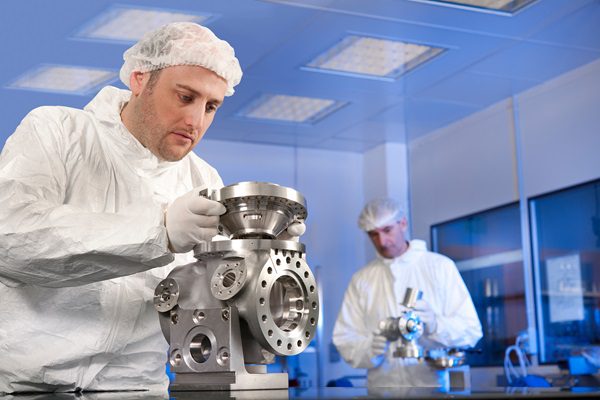
According to cleanroom regulations, these areas must have strict controls over the cleanliness of personnel and equipment entering them. Complete cleanliness is usually guaranteed through equipment included in these rooms. Some examples are air showers and fume hoods.
To obtain GMP certification, an application must be submitted to the Spanish Agency for Medicines and Health Products (AEMPS). This application must be accompanied by a technical report or prequalification dossier demonstrating compliance with GMP regulations. Submitting this documentation typically takes about two weeks and involves two audit stages:
The site facilities are assessed, during which auditors visit the manufacturing location for 3-5 days.
The product is assessed, for which auditors examine samples from production batches.
The certification cost is primarily due to the preparation of the technical report, which is very expensive and involves a lengthy compliance process, typically taking one to two months. This audit process varies by country, as audits may be required annually or biennially, and non-compliance can lead to the suspension of the manufacturer's commercial operations and/or the cancellation of their registration.
In conclusion, it is crucial to emphasize the importance of complying with GMP standards for cleanrooms. This compliance is essential to ensuring the quality of products and processes in various industries. Therefore, putting yourself in the hands of experienced professionals is the safest and most feasible option, and remember that if you don't know how to obtain your GMP certificate or have doubts about what obligations you have according to your sector, you can contact us and we will answer all your questions.
Cross-contamination occurs when a product or material containing a potentially contaminating or harmful substance comes into contact with another product that should not be exposed to that substance. The contact between the two products results in contamination, as a substance that might not harm one product can render another unfit for sale.
In addition to good manufacturing practices, there is the ISO standard, which cleanrooms must also follow to ensure that everything is correct, meets the relevant standards, and can be used safely.
Yes, for any company that needs to comply with certain GMPs in order to produce its products, a cleanroom that does not meet the regulations can lead to the authorities not allowing the production and sale of the company's products, so it is essential to comply with the established guidelines.
The objective of GMP standards for cleanrooms is to ensure that there are correct practices in their design and use that guarantee that safety and quality standards are met.
GMP and ISO regulations refer to cleanrooms as places where manufacturing processes for cosmetics, medical devices, medicines, food, etc. take place, both in the form in which they reach the end consumer and in their preparation for hospitals and clinical trials.
In addition to the requirements relating to the design of the cleanroom, the staff is also important when it comes to complying with GMP regulations, specifically regarding ensuring the cleanliness of both themselves and the equipment they use during their time inside the room.
A GMP audit involves an audit conducted by a third party to determine if your company is complying with the safety guidelines and best practices detailed in the GMP regulations.