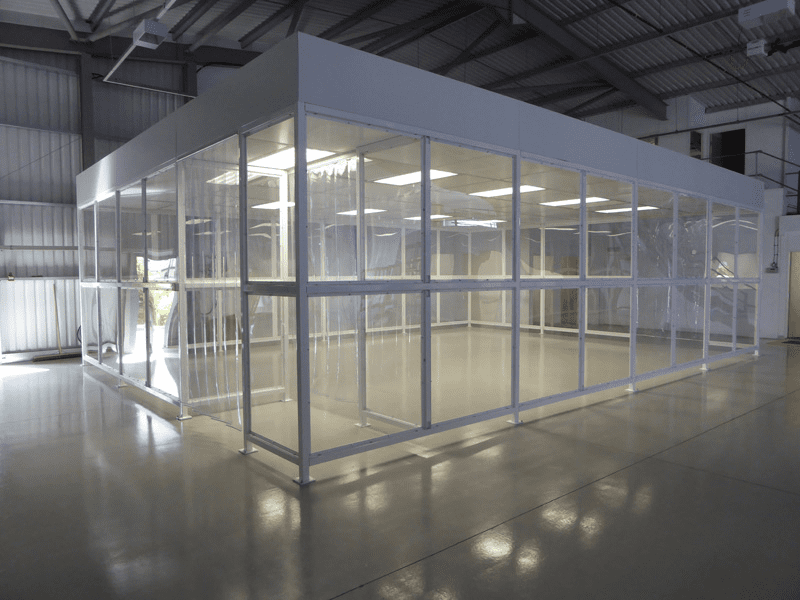
There are certain processes that require absolute control of the environment to ensure product excellence. Especially in sectors such as the chemical, food, and cosmetics industries, it is common to require a 100% isolated area to prevent any contamination, whether internal or external. This approach aims to ensure, on the one hand, safety and, on the other, that processes are carried out correctly. In such situations, our greatest allies are the various types of laminar flow cabinets. Today we’ll tell you all about their features, differences, and, ultimately, everything you need to know about laminar flow cabinets for cleanrooms.
The equipment known as laminar flow hoods or cabinets are, broadly speaking, spaces subjected to specific air treatments, allowing for the creation of areas with strict control of airborne particles. Their operation consists of creating "air barriers," which allows air to flow at a constant speed in a single direction—thus eliminating turbulence—a process also known as laminar airflow.
In this way, laminar flow hoods or cabinets are designed as enclosed spaces on three sides, with a fourth side partially open to allow access to the work surface, and they feature directed ventilation of clean air. The cabinets include an air blower, a distributor, a filter, lighting, and a pressure gauge.
Laminar flow hoods are commonly used in microbiological control procedures, sampling, and weighing areas; however, they are also used in a multitude of scientific processes, from in vitro fertilization to clinical analyses and tissue culture. They are a key piece of equipment in any reputable laboratory, and therefore, laminar flow hoods are essential in many sectors depending on the processes being carried out.

Cleanliness in these ventilated enclosures, known as laminar flow chambers, is achieved through the use of HEPA filters, which trap particles carried by the airflow. These filters are 99.995% effective at removing particles of 0.3 µm, providing a constant flow of clean air at a speed of 0.3 to 0.5 meters per second. In this way, the chambers create a sterile environment free of foreign bodies, enabling the performance of all types of activities and processes requiring sterile conditions.

The uses of laminar flow hoods are varied, as they can be used, depending on the airflow configuration, to prevent contamination of the product being handled, to protect the operator, or to protect both. Therefore, several types of laminar flow hoods exist to meet these requirements, although the term "laminar flow hood" is strictly applied only to Class I hoods.
There are two types of laminar flow hoods depending on the position of their HEPA filter. They are called vertical laminar flow hoods if the filter is located at the top and horizontal laminar flow hoods if it is located at the rear. The difference between these two types of hoods is quite simple.
In a horizontal laminar flow hood, the filtered air comes from the rear, where the HEPA filter is located. The air passes through the main chamber in a horizontal, unidirectional flow and is expelled through the front opening. In a vertical laminar flow cabinet, clean air enters from the ceiling, where the air filter is located, and passes through the chamber to the floor. It is then expelled through the front opening, just as in horizontal laminar flow cabinets.
On the other hand, another classification for establishing types of laminar flow cabinets, apart from the division between vertical and horizontal, is the following:
1
Class I cabinets maintain a continuous, unidirectional flow of filtered air, which can be either vertical or horizontal. The sole function of these cabinets is to protect the product being handled, as the air is directed toward the operator.
The work surface inside the laminar flow cabinet is typically made of high-quality stainless steel, with curved side edges (sanitary finishes) to facilitate cleaning and disinfection, and without seams where contaminants could accumulate. The standards governing these cabinets are IEST-RP-CC002.3 and, to a lesser extent, NSF/ANSI-49.
2
Class II fume hoods are designed to protect both the object being handled and the operator. These hoods feature vertical airflow, horizontal airflow, and a protective screen. They also have two HEPA or ULPA filters: one before the gas inlet and another that prevents the handled components from escaping. These hoods are used for cell cultures or cultures of potentially low-risk pathogens, although several subclasses exist depending on the specific work to be performed.
3
This cabinet is a sophisticated version of the Class II cabinet, in which a high-risk pathogen is handled under completely sealed conditions. Class III cabinets contain additional reservoirs and filters where samples and aerosols from the work area are dispersed before being discarded. In this type of cabinet, the operator does not come into contact with the object being handled except through indirect means.
This is why laminar flow cabinets are commonly found in cleanrooms. These rooms minimize external contamination, facilitating the operation of the hoods and extending the lifespan of the filters. The efficiency of the cleanroom depends on the strategic placement of the laminar flow cabinets. The installation position of the cabinets will depend on their purpose (based on the hood class and the laboratory's workflow) and on the balance between the value of the sample, the safety of the operator, and the importance of external contamination.
At Labsom, we are experts in the design, installation, and maintenance of both laminar flow cabinets and cleanrooms, along with all their components. If you have any questions or would like to discuss your project with us, please don't hesitate to contact us.
Laminar flow occurs when a flow of particles or fluid has a perfectly ordered and controlled movement in the form of parallel sheets that allow the flow to move without mixing, which can be very useful in the context of a cleanroom.
The difference between the two lies simply in the direction of airflow within the hood. If the filter is located on the ceiling, the airflow will be vertical, moving from top to bottom, while if it is located on one of the walls, the airflow will be horizontal.
There isn't one cabin that's inherently better than another; it depends on the intended use. Of course, Class III cabins offer the highest safety standards and requirements, but they may not be necessary depending on the work being performed.
One model isn't necessarily better than the other. Vertical fans are better when working with pollutants or toxic products because they protect the user. Otherwise, horizontal fans offer less airflow turbulence. It all depends on the processes being carried out.
These types of facilities must comply with the relevant ISO and GMP standards, as well as with the specific requirements and regulations corresponding to the sector in which the activities to be carried out within them are framed.