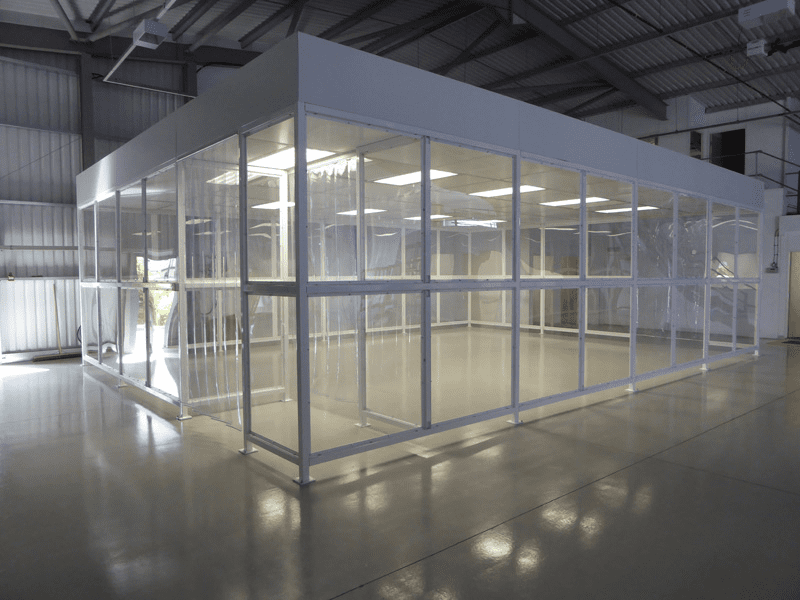
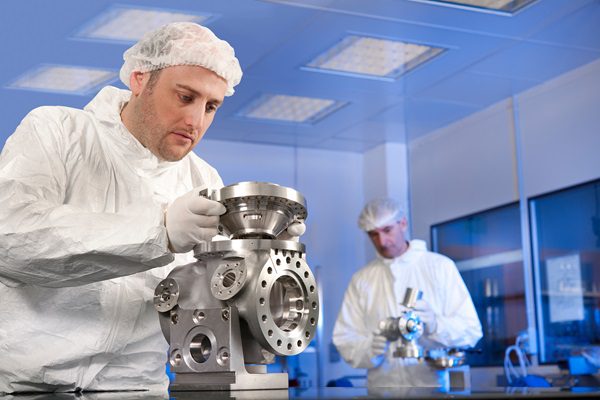
Cleanrooms are facilities used in technological or scientific fields to prevent potential cross-contamination, the presence of abrasive substances, or to certify a product’s sterility. Cleanrooms are classified according to the particles present in the air; however, there are various standards governing this. This is why we sometimes come across such varied references as ‘Class 1000 cleanrooms’, ‘Grade B’ or ‘ISO 8’, which can be confusing. Find out how cleanrooms are classified and what criteria are used to determine which class they belong to.
The classification of cleanrooms depends on the terms of definition. According to ISO standards, one of the most common and legally mandated, cleanroom types are established based on the level of stringency regarding the maximum size and number of particles present in the room. Thus, and always in accordance with the first section of this standard, nine categories are established, from ISO Class 1 to ISO Class 9, with Class 1 being the most restrictive.
However, the ISO classification is not the only one. In the pharmaceutical industry, for example, it is also mandatory to comply with Good Manufacturing Practices (GMP), which classify cleanrooms from the most restrictive Class A (equivalent to ISO Class 4) to Class D (equivalent to ISO Class 8).

ISO standards establish 11 precepts that must be followed for a cleanroom to be considered safe and environmentally friendly. In addition to considering air purity from airborne particles, there are 10 other sections that define the conditions for different types of cleanrooms. In fact, some sections within the ISO standard contain their own classifications, although these are not widely used.
Fuente: Original work
In this way, companies that need to use a cleanroom can easily determine what type of controlled environment they require based on the specifics of their production processes. It's a simple way to establish a standard to follow, although this standard is usually updated every few years.
The ISO classification is not the only one available. In the pharmaceutical industry, it is also mandatory to comply with the Good Manufacturing Practices (GMP) guidelines, which classify rooms according to air cleanliness, from the most restrictive Class A (equivalent to ISO Class 4) to Class D (equivalent to ISO Class 8).
A
For particle classification, its equivalent is ISO 4.8, whose particle size limit must be less than or equal to 5.0 μm.
B
Grade B refers to rest, whose classification for both sizes taken into consideration is ISO 5 cleanroom.
C
It refers to both at rest and in operation, and the established classification is equivalent to ISO 7 and ISO 8 cleanrooms. It is intended for sectors where it is necessary to work in an environment with completely clean air, for example in the pharmaceutical and food industries.
D
This refers to ISO 8 and pertains solely to rest periods. These rooms are typically used for the least critical phases of the process. ISO 8 air quality must range between 0.5 and 5 microns, and the concentration cannot exceed 3,520,000 in the first case, and 29,300 in the second.
But, in addition to the two classifications we have seen and which are the most used (especially the ISO), there are other types of cleanrooms and ways to classify them, such as the following:
The US FED-STD-209E standard (or Federal Standard 209E) designates cleanrooms as "Class 10," 100, 10,000, etc. This refers to the number of particles 0.5 microns or larger that are permitted per cubic foot of air, and can go up to Class 100,000. In other words, a Class 100 cleanroom must be designed to allow no more than 100 particles of 0.5 microns per cubic foot of air. This is easily comparable to ISO 5.
Thus, Class 100 cleanrooms are the first classification where no particles larger than one micron are allowed. This type of cleanroom therefore requires an excellent filtration system and specific equipment, and is typically used by the pharmaceutical industry.

Although it may seem obvious, you can define the type of cleanroom you need based on your specific requirements. Standards and guidelines can provide direction, but some people have doubts about the classification their businesses truly require. To determine this, we must consider the implications in terms of investment, operating, and design costs for each type of cleanroom. However, the most important factor in determining the type of cleanroom you need is the industry.
Therefore, when faced with the question of "what type of cleanroom do I need?", there are various possible solutions depending on the requirements, and it's essential to consider the economic and technical advantages and disadvantages. The best solution isn't necessarily the most expensive, but rather the one that best suits your needs. For this reason, the best way to ensure success is to contact experienced professionals like Labsom, so that you make the best possible decision.


Cleanrooms are used throughout the pharmaceutical, chemical, and biological industries, as well as in human or veterinary hospitals, universities, and research laboratories.
When we talk about ISO 8, we are referring to the second lowest classification of cleanrooms. In the case of ISO 8, particles can range from 0.5 to 5 microns in size.
The ISO 7 cleanroom is focused on sectors where it is necessary to work in an environment with completely clean air, such as the pharmaceutical or food industries, where air control is rigorous.
ISO Class 5 allows up to 29 particles of 5 micrometers or less in the same volume. For reference, ISO Class 1 allows up to two particles of 0.2 micrometers per cubic meter of air.
There is no single best or worst type. ISO 14644-1 establishes different types based on air quality levels. The most appropriate type should be chosen according to the level of safety required for the activities to be carried out in the room, in order to comply with the regulations established for each sector.
The pharmaceutical sector currently uses the most cleanrooms that fall under the Class 100 category. This is because the characteristics of these cleanrooms are ideally suited to the processes required by this sector.
It depends. Cleanroom classifications are based on the level of air cleanliness within the room. Depending on the processes performed inside, a higher or lower maximum particle level may be required to ensure safety.