What you need to know about cell cultures in clean rooms:
- A laminar flow booth o Biological safety protects the sample locally, while the clean room controls air quality and pressure throughout the room.
- Particle air classification (ISO 14644-1) should not be confused with Biosafety levels (BSL), which determine the degree of containment against pathogens.
- Class II booths: They are the standard in cell cultures due to their ability to simultaneously protect the sample, the operator and the environment.
- The architectural design of locks (SAS) and pressure cascades prevents cross currents and contaminated air inlet.
- Labsom addresses projects from the cleanroom engineering and the White Room Design, until Cleanroom validation and plant installation.
What is cell culture in the clean room?
Carrying out cell cultures in the clean room involves transferring the cell biology protocols to an enclosure where the concentration of particles and the microbiological charge of the air remain within strict limits.
This protected environment is designed to protect four fundamental pillars:
- cells and cultures: Its loss by fungal, bacterial or mycoplasma contamination is prevented.
- THE PROCESS: Deviations generated by the presence of inert powder or aerosols are prevented.
- The technical staff: The operator’s health is shielded when manipulating human cell lines, viral vectors or pathogens.
- The reproducibility of the trials: Uncontrolled environmental variables that alter scientific results are eliminated.
Differences between work environments
- Conventional Laboratory: Standard workspace without absolute air filtration where the samples are exposed to the environment.
- Aseptic work area: Local containment area within a room (such as the interior of a cabin) that generates a clean flow over the sample.
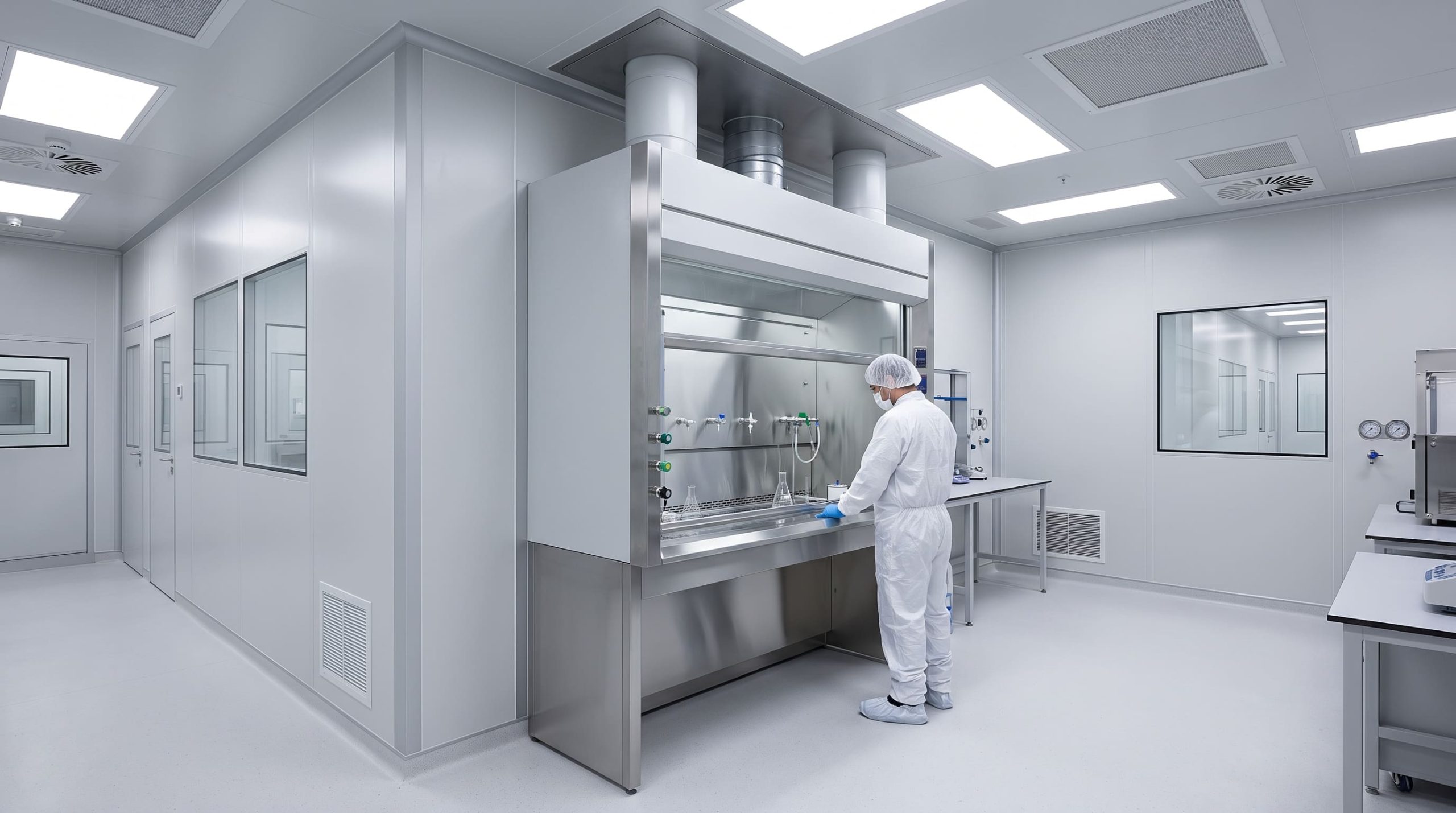
- White Room: Hermetic enclosure where all the volume of air is treated, filtered and renewed by means of HVAC systems to guarantee a category of uniform purity.
Why is a clean room used for cell culture?
Cell lines lack a functional immune system; Any suspended microparticle or spore falling on the culture plate or flask can destroy the cell population in hours.
A controlled environment is used to:
- Reduce the risk of cross contamination: Turbulent air currents that carry contaminants are minimized.
- Maintain constant environmental conditions: The temperature and humidity are regulated to prevent the evaporation of the culture media.
- Protect high value crops: In biotechnology or regenerative medicine, the loss of a lot implies unaffordable economic and temporary costs.
- Guarantee reproducibility: Maintains identical physicochemical parameters between different batches of experimentation.
- Comply with quality regulations: imperative compliance in areas such as GMP standards in the pharmaceutical industry.
- Provide standardized protocols: It allows to operate under reproducible standardized operating procedures (SOPs).
What requirements must a clean room for cell culture meet?
An enclosure intended for cell processing requires a technical infrastructure that covers multiple parameters:
Control of suspended particles
Air purity is determined according to the maximum particle concentration per cubic meter according to international standard ISO 14644-1. Stays must maintain strict limits according to the criticality of the processing phase.
HEPA air conditioning and filtration system
The Air treatment in clean rooms You must guarantee:
- Continuous Renewal: Multiple air changes per hour to sweep away indoor pollution.
- Absolute filtration: through the Use of HEPA H14 filters in laboratories with a filtration efficiency of 99.995%.
- temperature and humidity: thermal stability (20 – 22ºC) and controlled relative humidity (45 – 55%).
- Differential pressure: Positive pressure to protect healthy outdoor air samples, or negative pressure if infectious agents or biosecurity are processed.
Microbiological contamination control
Periodic air sampling by plate sedimentation, active biological samplers and surface imprints to verify the absence of germs.
surfaces and materials
Sanitary paneling walls, continuous epoxy resin floors and corners with half-round profiles. The surfaces must be resistant to intense chemical disinfection agents such as isopropyl alcohol or hydrogen peroxide.
Access control and flow of personnel and materials
zoning through interconnected step locks through a system of Door interlock for clean rooms to avoid simultaneous openings that break the pressure cascade.
What equipment does a cell culture laboratory need?
Furniture and instruments must be integrated flush so as not to alter the dynamics of airflows:
Biological safety booths
Primary containment systems essential for aseptic manipulation. The Biological safety booths Class II are the most used in cell culture, since they recirculate the air through HEPA filters to protect the product, the technician and the environment.
cell culture incubators
Equipment that maintains the optimal atmosphere for cell growth, regulating the temperature 37ºC, humidity and CO2 concentration.
centrifuges
Preferably with oscillating rotors and hermetic safety cups to prevent aerosol generation during centrifugation of cell suspensions.
microscopes
Phase contrast inverted microscopes located near the cabins to inspect the density, morphology and confluence of cells without prolonged displacement.
Storage and conservation systems
- Refrigerators and freezers: Conservation of reagents, sera and culture media at 4ºC, – 20ºC – 80ºC.
- Cryopreservation systems: Vapor phase liquid nitrogen tanks for long-term cell storage.
What kind of clean room is needed for cell culture?
There is no single generic category applicable to all projects; The choice must be linked to the requirements of the process:
| Culture Application |
Environmental Control Requirements |
Design Considerations |
| Basic research |
Local contamination control |
Biosafety cabinet in a well-ventilated room. |
| Advanced culture research |
Aseptic zone + particle control |
Clean area equivalent to ISO 7 or ISO 8. |
| Industrial biotechnology |
Process control and traceability |
ISO 7 / ISO 6 classification with support rooms. |
| Advanced therapies / CAR-T |
High microbiological and regulatory control |
Grade A is ISO 5
Grade B is ISO 5 at rest and ISO 7 in operation. |
| Large-scale cell production |
Comprehensive control of flows and hygiene |
Zoned modular design with multiple airlocks. |
SOURCE: OWN ELABORATION
White room or laminar flow booth for cell culture?
It is essential to differentiate the level of protection of each element before investing in the infrastructure:
- Laminar Flow Cabin: Exclusively protects the product inside by injecting filtered air, but does not protect the operator or control the room where it is located.
- Biological safety booth: It protects the product, the operator and the environment through air barriers and extraction HEPA filtration, but its action is punctual.
- White Room: Controls air, pressure, temperature, humidity and particles throughout the room. It is necessary when the process requires the manipulation of cells outside the cabin, when multiple equipment is connected or when the regulations require it.
How should a clean room for cell culture be designed?
The architectural design of the room is based on the guidelines of the standard ISO 14644-4:
- Distribution of zones: Separation of the main grow room from the media preparation, washing and storage areas.
- Staff, Materials and Waste Flows: Circuits that prevent waste or clothing from crossing with sterile reagents.
- Locks and changing rooms (SAS): intermediate steps for the change of technical dress and introduction of material through Pass box systems.
- Air conditioning and filtration systems: Air treatment units (UTAS) sized to ensure necessary hourly renovations.
- Materials and finishes: smooth panels, Types of doors for clean rooms watertight and white room furniture stainless steel.
- Equipment location: Incubators and cabins must move away from access doors to prevent drafts from disturbing the equipment protection curtain.
What rules apply to a cell culture clean room?
ISO 14644-1: Air Cleaning Rating
Sets the ISO classes according to the concentration of suspended particles of different sizes per cubic meter.
ISO 14644-3: Testing and Verification of Operation
Define the mandatory test methods for checking room status: Particle Recovery Tests, Filter Leak Test, and Flow Measurements.
ISO 14644-4: Design, construction and commissioning
It provides the technical guide to develop clean room projects from initial engineering to final delivery.
Biosafety regulations and requirements
The Biosafety levels (BSL-1 to BSL-4) are determined based on the type of pathogen or manipulated cell line, dictating biological containment measures according to WHO guidelines.
How is contamination controlled in a cell culture?
To prevent crop loss, strict operating procedures are applied:
- Particle control: Keep the HVAC system in continuous operation with preventive maintenance of filters.
- Microbiological control: Cleaning and disinfection of surfaces with validated and rotary biocides (eg 70% isopropyl alcohol and sporicides).
- Control of materials and supplies: spraying of containers with disinfectant in the Pass box systems before putting them in the clean area.
- Staff clothing: Technical pajamas, sterile gown or jumpsuit, white room shoes, hat, mask and non-pudding gloves.
- Aseptic work procedures: Work in the center of the biological safety booth, avoid sudden movements of the personnel and do not obstruct the vents.
How do you validate a cell culture clean room?
Validation is the documented process that shows that the room meets the design specifications:
- Particle count: Verification of the ISO class according to ISO 14644-1.
- HEPA Filter Integrity Test: Checking for absences of leaks in the filter medium and frames.
- Differential pressure measurement: Verification of pressure cascades between adjacent rooms.
- Flows and renovations per hour: Determination of the volume of injected air.
- Temperature and humidity studies: Thermal mapping at different points of the enclosure.
- Flow visualization tests: Smoke tests to check for the absence of dead zones or turbulence.
- Microbiological tests: Sampling of air and surfaces in a state of rest and in operation.
- DOCUMENTATION: Consolidation of the installation qualification dossiers (IQ), operation (OQ), and performance (PQ).
How much does a clean room for cell culture cost?
The budget of a clean room is not set for a standard rate per square meter. If you want to know the investment forks in Spain, you can consult our guide on How much does it cost to set up a clean room.
Factors that determine the cost of the project:
- Useful surface and height: Volume of air to be treated by the air conditioners (UTAS).
- ISO rating and pressure jumps: Number of absolute filters and gates required.
- Biosecurity level (BSL): Inclusion of extraction systems with HEPA filtration in the air outlet.
- Lock architecture: Number of locker rooms and Pass Box modules with interlocks.
- Monitoring systems: Network of fixed particle sensors, humidity and pressure in real time.
- Scope of validation: Level of documentation and physical tests required.
How to choose a company to design a cell culture clean room?
The execution of a clean cell culture requires the coordination of engineering disciplines, sanitary architecture and metrological validation:
- Accredited experience: Trajectory in the construction of clean areas for biotechnological and sanitary laboratories.
- Process tailored design: Ability to project custom distributions according to customer flows.
- Engineering and installation capacity: Turnkey execution of enclosures, air conditioning and lighting.
- Official validation: Issuance of protocols and technical reports valid for quality audits.
- Maintenance service: After-sales coverage for annual requalifications and supply of spare parts.
On LABSOM We offer comprehensive support from consulting services initials until start-up, also having alternatives for Modular white rooms adaptable to pre-existing spaces.
Frequently Asked Questions about White Room Cell Culture
Is it mandatory to use a clean room for cell culture?
Not in all cases. For university or basic research, it is enough to work inside a biological safety booth located in a specific cultivation laboratory. However, for the manufacture of medicines, advanced therapies or regulated biotechnological products, the use of cleanroom is a legal requirement.
What ISO class does a clean room for cell culture need?
Rooms are usually projected as ISO 7 or ISO 8 for the general work environment, reserving local class zones ISO 5 (such as the interior of the cabins) for direct aseptic handling of the sample.
What is the difference between a clean room and a laminar flow booth?
The laminar flow booth provides a spot clean area on your work surface. The White Room is a complete enclosure that controls the particles, the temperature, the humidity and the pressures of the entire room.
What booth is used for cell culture?
The most used are the Class II biological safety booths. They provide protection to the product, the laboratory technician and the environment through HEPA filtration and uninterrupted air injection.
What temperature does a cell culture laboratory need?
The temperature of the room is programmed between 20ºC and 22ºC To guarantee the comfort of the technical staff dressed in sterile clothing and avoid overheating of the equipment. The cells are kept at 37°C within the incubators.
How is the contamination of a cell culture avoided?
Combining hepa air filtration from the room, the use of class II cabins, sterile staff clothing, methodical disinfection of materials in the Pass Box locks and the rigorous application of aseptic work techniques.