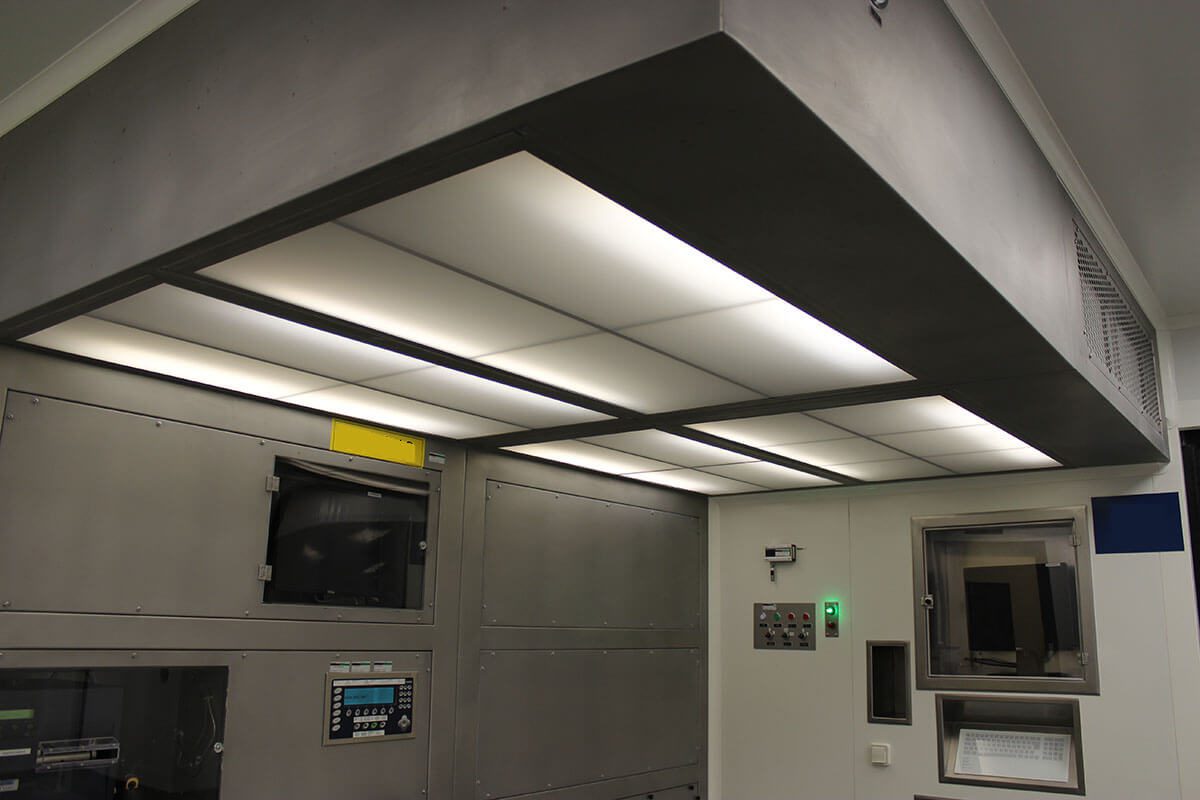
What you need to know about the types of doors for clean rooms:
- The doors not only close a space; They protect the cascade from pressure and prevent the loss of air quality during the passage of personnel or loads.
- Any door intended for a controlled environment must have fully flush finishes, without exposed edges, moldings or cavities where dust or microorganisms accumulate.
- Depending on the needs of space and transit, folding doors (simplicity), sliding (space saving), fast rolling (high materials transit) and hermetic (high containment) are used.
- In critical transfer zones, the doors are connected to a white room door interlock to prevent simultaneous openings and maintain tightness.
- The doors are not certified in isolation by the ISO 14644 standard, but are part of the comprehensive design that allows validating and qualifying the enclosure successfully.
What characteristics should a door for a clean room have?
Before evaluating the types of doors for clean rooms, it is essential to define the engineering and sanitary design requirements that any enclosure installed in a classified environment must meet:
- Smooth and easy to clean surfaces: They must have non-porous finishes that support frequent cleaning with aggressive chemical agents and biocidal disinfectants without degrading.
- Low generation and particle accumulation: Building materials should not release fibers, chips or microparticles by friction or mechanical fatigue.
- Sealing and pressure control: They must incorporate flexible perimeter seals (in frame and guides) that reduce air leaks, guaranteeing the maintenance of thermal and pressure gradients.
- Resistance to cleaning and disinfection products: They have to withstand continued contact with isopropyl alcohol, quaternary ammonium compounds, bleach, or hydrogen peroxide vapor decontamination (VHP) systems.
- Resistance to use and transit: They must be prepared to withstand impacts from cars, pallet trucks or intensive personnel passage without suffering deformations that compromise their alignment.
- Flush design: The peepholes, gazebos, glass visors and frames must be completely flush to the same side of the door leaf and the wall panel, eliminating shelves or edges where dirt can be deposited.
What types of doors are used in clean rooms?
There is a specific typology adapted to each logistics flow and level of containment within the facilities:
Folding doors for clean rooms
They are the most widespread traditional solutions for the pedestrian crossing. They operate by integrated stainless steel hinges or self-lubricated polymeric materials.
- Main features: They provide great mechanical simplicity, very easy disinfection and excellent sealing thanks to the direct adjustment of the blade against the frame joint.
- usual materials: Lacquered steel panels, stainless steel or high-density phenolic resin.
- when are they a good option: Ideal in access to locker rooms, general communication corridors and entrances to laboratories where there is enough space for the opening sweep of the sheet without invading passage areas.
Sliding doors for clean rooms
They are designed to maximize the use of usable space. They move parallel to the septum or inside a flush suspended upper guide.
- Advantages in space: They completely eliminate the front turning radius towards the corridor or the room, facilitating the transit in narrow or high-density rooms. white room furniture.
- Automation: They lend themselves optimally to automated motorization by means of radar motion sensors, photocells or elbow/foot buttons.
- common applications: Component preparation areas, hospital operating rooms, packaging rooms and distributors with high passing flow.
Rolling doors for white rooms
They are fast doors made of technical PVC canvas or metal slats designed for industrial zones with intense logistics movement.
- Opening speed and tightness: They operate at high elevation speeds, drastically reducing the time in which the room is exposed to the outside. They incorporate low-friction self-repairing side guides that ensure a remarkable level of tightness against air leaks.
- stainless steel finishes: At Labsom we highlight the use of fast rolling doors made with chassis and stainless steel structure. This configuration guarantees maximum durability against corrosion in the pharmaceutical industry or in areas with demanding cleaning requirements.
- Integration with automation: They are natively connected to magnetic loop detectors in soil, field radars and plant automata.
Airtight doors for clean rooms
They represent the maximum level of insulation and pneumatic or mechanical sealing.
- tightness mechanism: When closing, the blade makes a downward and transverse movement on the frame, exerting pressure on the perimeter joint that seals the passage of air at 100%. Some models use inflatable gaskets that expand with compressed air when fitting the door.
- Applications in critical zones: Fundamentals in facilities with high Biosafety levels, areas of containment of viruses and bacteria, high biological containment laboratories and areas with the presence of gases or VHP.
How to choose the right type of door for a clean room?
The final selection must be the result of an engineering cross analysis where the following operational factors are weighted:
- According to the level of cleanliness required: In Grade A or B enclosures of the GMP, flush seals are prioritized with hermetic sealing, while in a Grade D or ISO 8 room, conventional folding models can be installed.
- According to the pressure difference between rooms: The greater the differential pressure jump, the greater the retention capacity and mechanical rigidity of the door to prevent air leaks or pneumatic thrust misfits.
- According to the step frequency: In continuous passage accesses, it is convenient to automate the opening to prevent operators from touching handles with disinfected gloves.
- According to the type of transit:
- People only: standard folding doors or sliding doors.
- Carts or pallets: Double-sheet doors, sliding doors with a great passage light or fast rolling up.
- According to the available space: Narrow spaces or saturated corridors require the integration of sliding doors to avoid physical interference.
- According to automation needs: If the flow requires integration with FMS/BMS technical management systems or biometric readers, sliding and rolling machines offer more direct electronic integration.
- According to cleaning and disinfection processes: In areas exposed to intense chemical disinfection or gaseous hydrogen peroxide, the materials must be inert (AISI 304/316L stainless steel or phenolic resin).
Comparison of types of doors for clean rooms
The following table summarizes the usual advantages and applications of each enclosure type to facilitate decision-making in the preliminary phase:
| Tipo de puerta |
Principal ventaja |
Aplicación habitual |
Automatización |
| Abatible |
Sencillez, ajuste neumático directo y bajo coste |
Accesos de personal y esclusas individuales |
Opcional |
| Corredera |
Ahorro total de espacio frontal de paso |
Pasillos, quirófanos y zonas de alto tráfico |
Recomendada / Sí |
| Enrollable rápida |
Velocidad de apertura y contención térmica |
Alto tránsito de materiales, almacenes y muelles |
Sí (de serie) |
| Hermética |
Sellado neumático absoluto contra fugas |
Áreas críticas, bioseguridad y aislamiento |
Recomendada / Sí |
Fuente: Elaboración propia
What materials are used in cleanroom doors?
The durability, chemical resistance and emission rate of particles depend on the nature of the chosen components:
- Stainless steel: It is the reference material par excellence (AISI 304 or AISI 316L varieties). Provides unmatched resistance against corrosion, withstanding continuous cleaning with aggressive disinfectants, being the standard in the White rooms for the pharmaceutical industry.
- Lacquered steel / galvanized sheet: Steel sheet coated with thermoset powder paint (epoxy or polyester resin). It offers a smooth surface, tightness and excellent value for money for White rooms for the food industry or other sectors less corrosive.
- Phenolic resin: Non-porous high-density plates with very high mechanical resistance against mechanical shock. to deepen the behavior and Uses and properties of phenolic resin, you can consult our specialized technical guide on this material.
- Other materials and finishes: Tempered or rolled safety glass, internal insulated polyurethane injected or fireproof rock wool according to the fire resistance (RF/EI) requirements of the project.
Automation and control systems in clean rooms for clean rooms
The sensorization and digitization of the accesses raises the level of biological safety and operational efficiency of the plant:
- Automatic opening: Smooth moving brushless electric motors with controlled acceleration and braking ramps that prevent vibrations and air jerks.
- Sensors and drive systems: “Non-touch” capacitive proximity sensors (no-touch), infrared photocells, elbow pushbuttons and presence radars that prevent cross-contamination by manual contact.
- Access control: Integration with proximity RFID card readers, coded numeric keypad or biometrics readers to restrict passage only to authorized personnel.
- Door interlock systems: When there are two or more accesses that communicate areas with different levels of containment, it is mandatory to install a locking of doors for clean rooms. This system electronically prevents one door from opening if the other is not completely closed, protecting the pressures and the air cascade.
- Integration with the operation of the room: Direct connection of the state of the doors with the White room monitoring, allowing to register the opening frequency and send alarms to the central software if a door remains open longer than allowed.
White room doors according to their application
The following table helps to quickly define the ideal solution based on specific use in the plant:
| Aplicación operativa |
Soluciones recomendadas habituales |
| Acceso general de personal |
Puertas abatibles de una hoja o correderas enrasadas |
| Alto tránsito de materiales / Palés |
Puertas enrollables rápidas en acero inoxidable o correderas dobles |
| Áreas críticas de contención biológica |
Puertas herméticas con junta inflable o de sellado mecánico |
| Laboratorios de análisis y ensayo |
Puertas abatibles de resina fenólica o correderas automáticas |
| Quirófanos y áreas hospitalarias |
Puertas correderas automáticas enrasadas con cristal de visión |
| Transferencia pequeña de materiales |
Módulos específicos tipo Pass Box con enclavamiento |
Fuente: Elaboración propia
What regulations should the doors of a clean room meet?
It is essential to address regulatory aspects with technical rigor:
- Relationship with ISO 14644: It is a common mistake to state that “a specific door is certified by ISO 14644”. The ISO 14644 standard classifies the global air cleanliness in the clean room, does not certify loose components. The door is an integrating element that must contribute to maintaining the rate of particle concentration required by the room class through its design, materials and watertightness.
- GMP Requirements in Pharmaceutical Facilities: GMP standards guidelines in the pharmaceutical industry require that doors installed in sterile areas (grades A to D) be non-porous surfaces, easy to clean and disinfect, without exposed edges or edges, and interconnected by locks equipped with interlocking systems.
- tightness and other technical requirements: Depending on the project, CE marking regulations, fire resistance (EN 1634 tests / EI classifications), evacuation permits in emergency routes (EN 13637) and air permeability index (EN 13637) must be verified. 12207).
How is the maintenance and cleaning of the doors of a clean room?
To ensure the durability and pneumatic tightness of the doors throughout their useful life, the following actions must be scheduled within the Cleanroom Maintenance Plan:
- Surface cleaning: Periodic disinfection using cloths that do not release fibers soaked in neutral detergents or isopropyl alcohol, paying special attention to flush frames, peepholes and levers.
- Review of joints and closures: Visual and physical inspection of the elasticity of the perimeter sealing rubbers. If silicone or EPDM gaskets have cracks, stiffness or clearance, they should be replaced immediately to prevent air leaks.
- Automation check: Metrological verification of the correct operation of photocells, movement radars and anti-crushing systems of motorized doors.
- Preventive maintenance: Lubrication of hinges or hidden guides with non-toxic greases Suitable for clean rooms, adjustment of the alignment of the blade and checking the magnetic tension of the electromagnet closures.
- tightness check: Performing physical tests of pressure drop or smoke tests to validate that the enclosure joint prevents the uncontrolled passage of air between rooms.
How to choose a door for a clean room project?
As a practical checklist for engineers, architects and plant managers, the selection of enclosures must follow this sequence step by step:
- Define the classification and requirements of the room: Identify the ISO class or GMP grade of the environment.
- Analyze the flow of people and materials: Determine the necessary dimensions and if the step will be for operators, carts or pallet trucks.
- Determine pressure differences: Evaluate the thermal and static pressure jumps between the communicated rooms.
- Define the level of sealing required: Decide between perimeter sealing by contact seal or hermetic seal.
- Select materials and finishes: Choose between stainless steel, lacquered steel or phenolic resin according to the cleaning chemicals used.
- Determine if automation is needed: Decide the opening system (manual, automatic sliding, fast rolling).
- Integrate the door with the rest of the elements: Attach the door with the Air treatment in clean rooms and implement a system Door interlock for clean rooms.
- Validate the solution within the project: Ensure that the installation undergoes qualification tests (IQ/OQ) within the comprehensive project.
choose correctly between the different Types of doors for clean rooms It is a strategic decision that directly impacts regulatory compliance, tightness of the enclosure and the efficiency of the workflow. Integrate from the initial project phase the design of the door with the materials of the walls, the consulting services Engineering and access control systems is the only way to ensure a clean and safe environment. On LABSOM We offer you comprehensive advice on the White Room Design, the selection of sanitary enclosures and their subsequent qualification, ensuring the success of the operation of your facilities.
Frequently Asked Questions about White Room Doors
What type of door is best for a clean room?
There is no one door superior to another; The best option depends on usage. The folding doors They are excellent for pedestrian crossing due to their simplicity and low cost, the sliders They optimize space in hallways, roll up accelerate the passage of materials and hermetic They are indispensable in areas of high biological containment.
When is it recommended to install an airtight door?
It is essential in areas where the minimum air leak cannot be tolerated, such as isolation rooms in White rooms for hospitals, laboratories with BSL-3 or BSL-4 biosecurity levels, Enclosures exposed to periodic fumigation with hydrogen peroxide or areas with extreme pressure jumps.
Do the white room doors have to be automatic?
It is not mandatory as a rule that all doors are automatic, but it is highly recommended in areas of frequent passage to avoid manual contact of the operators, reducing the risk of cross-contamination and facilitating ergonomics
Which door is most suitable for areas with a lot of traffic?
For the continuous traffic of personnel, the Automatic sliding doors With proximity motion sensors. For the frequent passage of trucks, pallet trucks or materials, they must be installed Fast rolling doors in stainless steel.
Can white room doors incorporate windows?
Yes, in fact it is a recommended practice to improve visibility and security. The visors or peepholes must be manufactured with double glazed tempered or laminated and remain Completely flush to both sides of the blade so as not to generate edges or corners where dust accumulates.
Can cleanroom doors be installed in an existing installation?
Yes, it is completely viable through adequacy reforms. However, the mechanical compatibility with the existing panels must be previously verified, adjusting the profile of the flush, and integrating the new system with the network of cleanroom engineering and plant interlocks.
What maintenance do the doors of a clean room need?
They require periodic revisions that include cleaning with neutral biocides, verification of wear and elasticity of sealing joints, verification of presence sensors, realignment of sheet alignment and fire test in case of fires (fail-safe).