


NEWS
October 9, 2026
Modular white room vs. Conventional construction: when to choose each
HEPA H14 filters are one of the most effective air purification systems out there. We talk about its design, use and industrial applications.
Aspire, inspire. Aspire, inspire. People breathe about 23,000 times a day. We put a mixture of nitrogen and oxygen in the lungs, essential for human life. But undesirable friends also enter, such as vehicle gases, smoke coming from factories, aerosols, friendly little bugs that we know as dust mites, mold spores and contaminants such as ozone, carbon monoxide, lead or even arsenic.

A HEPA filter is a High Efficiency Particle Collector, can remove most harmful particles, including mold spores, dust and their mites, pet dander and other air irritating allergens. HEPA filters are effective thanks to their randomly braided fiberglass design. These retain the particles in three different ways: adhered to passing between the fibers, destroyed by colliding with them or blurring.
A HEPA filter, according to the European regulations EN 1822, must be able to effectively finish with at least 99.95% of the particles with a size of 0.3μm or greater. If we refer exclusively to the HEPA H14 filter, it must retain that type of particle at least 99.995% to be aligned with the EU standard.
To minimize the harmful effects of all these very unattractive intruders for human health, we have at our disposal two types of air filters, the ULPA and HEPA filters, that is, high-efficiency particle collector). Both filters are based on a special design of random braided glass fibers that retain harmful particles and let just the right air for our lungs. The main difference between the two filters lies in the size of the particles that each of them can screen.

Do you know how long a HEPA filter lasts?
A HEPA filter is a High Efficiency Particle Collector, can remove most harmful particles, including mold spores, dust and their mites, pet dander and other air irritating allergens. HEPA filters are effective thanks to their randomly braided fiberglass design. These retain the particles in three different ways: adhered to passing between the fibers, destroyed by colliding with them or blurring.
A HEPA filter, according to the European regulations EN 1822, must be able to effectively finish with at least 99.95% of the particles with a size of 0.3μm or greater. If we refer exclusively to the HEPA H14 filter, it must retain that type of particle at least 99.995% to be aligned with the EU standard.
To minimize the harmful effects of all these very unattractive intruders for human health, we have at our disposal two types of air filters, the ULPA and HEPA filters, that is, high-efficiency particle collector). Both filters are based on a special design of random braided glass fibers that retain harmful particles and let just the right air for our lungs. The main difference between the two filters lies in the size of the particles that each of them can screen.
HEPA filters had its origin in secret developments carried out by the American military for the purpose of being used for chemical, biological and radiological defense purposes. ‘After World War II, the Atomic Energy Commission (AEC) chose the military’s HEPA filters as its main device for the removal of particles in all air exhaust systems from nuclear facilities.’ (Energy Department, DOE) HEPA filters were first used in the Manhattan Project to prevent the spread of radioactive contaminants in the air and then marketed in the 1950s by the Cambridge Filter company and, as with So many other technological innovations (internet, without going any further).
The operation of HEPA filters occurs through a principle of mechanical filtration, where the particular ones are retained in a mesh of fibers arranged in the form of folds.
The filtration process of a HEPA filter is based on three main mechanisms:
HEPA filters must meet specific criteria to be considered as such. Usually, they must be able to trap at least 99.97% of the 0.3 micrometers in size particles, making them highly efficient at cleaning the air from contaminants. This feature makes them especially useful and valuable in environments where a clean, particle-free air is required, as in hospitals, , Laboratories, , Clean rooms and homes of allergy sufferers.
The HEPA filter is a category which is very important to know that you have to pass a test called DOP (scattered oil particles), before you can carry the HEPA label. The purpose of the DOP test is to measure the percentage of particles within the functioning filtration device. In this way, the rate of captured fine particles is determined. To obtain the HEPA tag, the particles must not exceed 0.3 microns. After this test, and Depending on the yield and efficiency percentages obtained, 5 classes or subcategories of HEPA particulate filters are determined:
H10 filter
85% retention
H11 filter
95% retention
H12 filter
99.5% retention
H13 filter
99.95% withholding
H14 filter
99.995% withholding
Currently, we can find HEPA filters in all kinds of industries and constructions, as well as in most air purifiers, which can be small and portable. These are its main applications today:
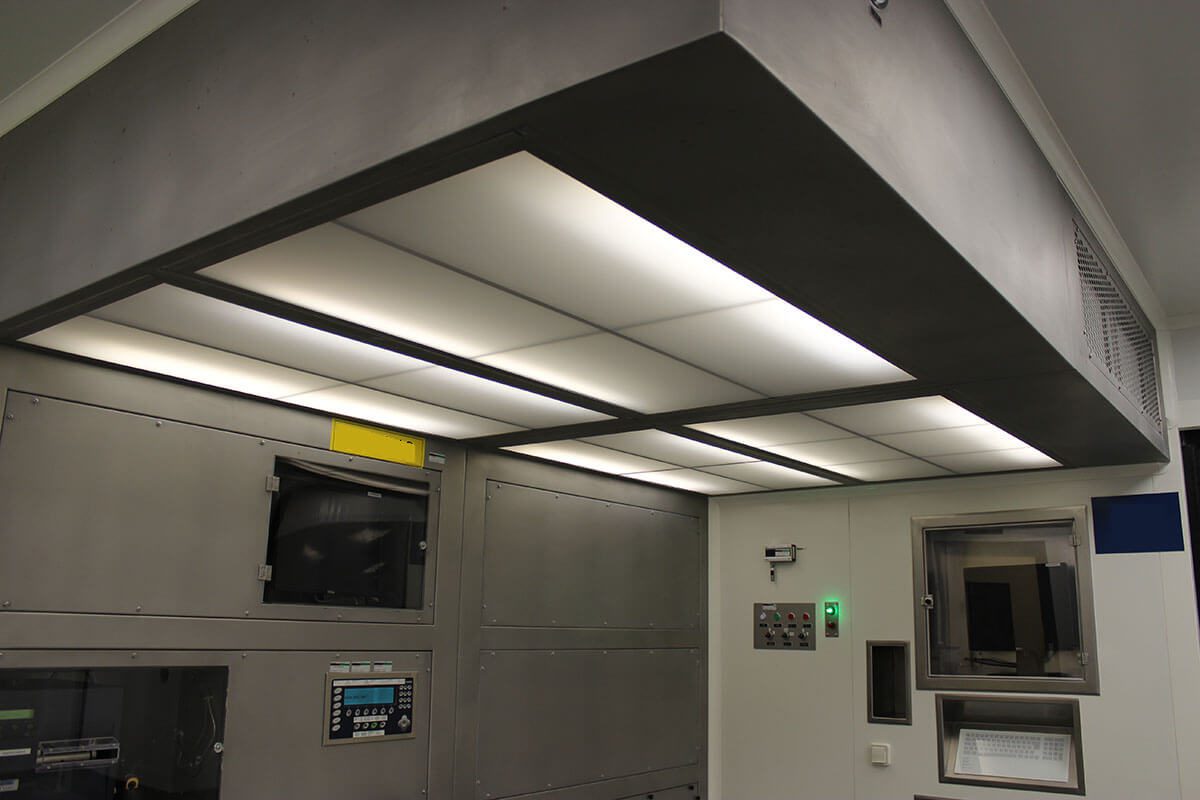
There are work and production areas that require 100% isolated to avoid any contaminants. For this kind of situation, Laminar flow cabins are revealed to be essential when generating air barriers that allow it to flow at a constant speed in a single direction. or ‘laminar airflow’. This eliminates air turbulence.
Depending on the positioning of the HEPA filter, the laminar flow booth will be vertical or horizontal. Be that as it may, in microbiological control procedures, sampling or heavy zones, for example, their installation is essential to achieve an isolated environment. this type of installation, and the presence of HEPA H14 filters, They offer the right guarantee for the safety of people and for the final product. It is also important to offer them daily maintenance and routine professional care.
At Labsom we are very aware of the primary role that HEPA H14 filters fulfill in the design and construction of clean rooms. Thanks to this commitment to safety, our products guarantee a great final result, thus making us allies of the health of all of us.
We handle the design, installation, management, and maintenance of cleanrooms, prioritizing safety and offering customized solutions. We will also contact you to discuss your project and prepare a quote tailored to your needs.